
The bell rings for break at Nduruma Primary School, and for years, that sound meant fifteen minutes of relief for most children. For a girl on her period, it meant deciding whether to risk the walk to a crumbling toilet block or simply stay in her seat and wait for the school day to end.
For years, twelve pit latrine-style stalls stood behind the school: their walls crumbling at the base and a rusted sheet of iron doing its best to pass for a roof. The doors barely closed. There was nowhere near to wash their hands afterwards. There was no privacy, and there was certainly nowhere a girl could go on the days her body needed discretion instead of exposure.


For many girls, home became the only place that offered the privacy school couldn’t. When their periods came, some stayed home too.
“When I was on my period, I worried more about going to the toilet than paying attention in class. Sometimes I just wanted the day to end,” Evelyne, a Standard 7 student.
Those missed days add up.
Three days each month become 48 days over a school year in the course of a girl’s education. What appears to be poor attendance can often be something far less visible: a child trying to navigate school without the dignity every learner deserves.
“There were days when some girls stayed home during their periods. We knew something was wrong, but we also knew the sanitation facilities were not giving them the confidence to stay in school.” Says Lucy, a teacher at Nduruma Primary School.

In 2025, the story started to change.
With support from the Coles Medlock Foundation, Ndoto in Action implemented a toilet construction project alongside its UK-based partner, Made With Hope, to replace the unsafe sanitation block with new facilities designed for the students who use them every day.
Fig: Nduruma Primary School’s newly constructed inclusive toilet
Today, the new facility includes separate sanitation blocks for girls and boys, a private menstrual hygiene room and accessible handwashing stations supplied by harvested rainwater, and a space for children with disabilities.


Fig: The inside look of the newly constructed toilet
Something as ordinary as using the toilet no longer had to become part of the day’s biggest challenge.

“The first day I used the new toilets, I felt comfortable. Now I don’t have to think about leaving school because of my period. I can stay in class like everyone else,” says Evelyne.
What changed was not just the building.
It was the confidence of a girl like Evelyne to stay at school during her menstruation period. The freedom to use a toilet without fear or embarrassment. The ability to focus on a lesson instead of worrying about the next break.
Every school day, more than 570 students now have access to facilities that protect their health, dignity, and education.
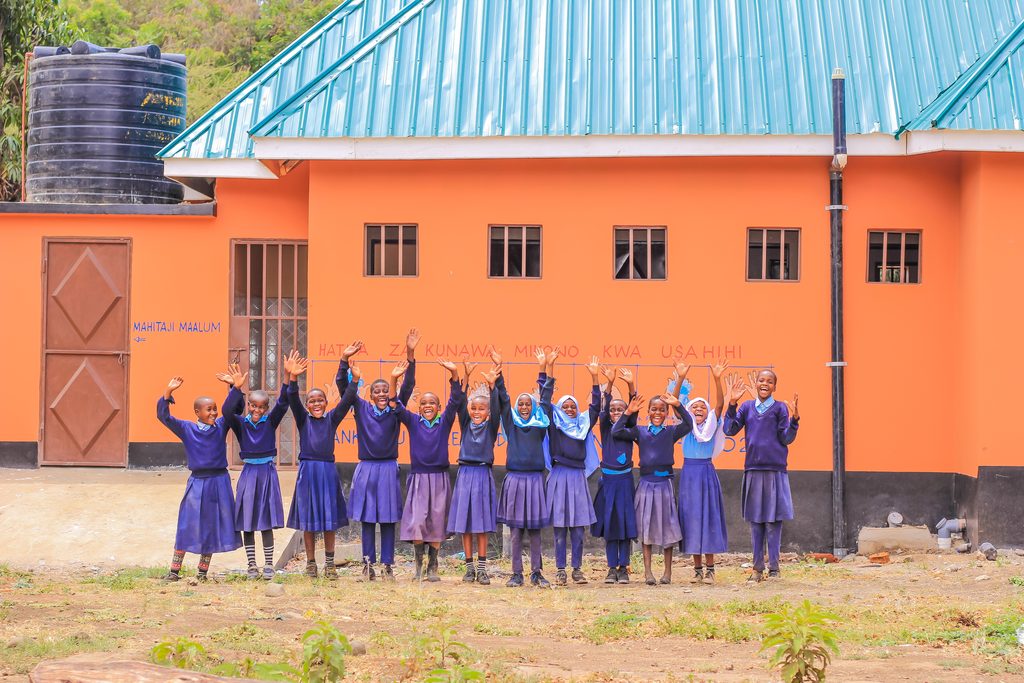
Fig: Students at Nduruma Primary School expressing happiness outside the new toilet
Sometimes, the biggest change isn’t adding something extraordinary. It is making something ordinary work the way it always should have.
How you can help
See more of our water, sanitation and Think Period projects, meet Nduruma and our other partner schools, or donate today to help transform another school in rural Arusha.