
Ruth is a small-scale farmer whose life was transformed by the feeding program we implemented at Umoja Primary School. A Maasai woman, married and gifted with 3 kids; Christine, a standard 5 child, Bridgit, a standard 3 child, both schooling at Umoja Primary School and Prisca, the youngest. Having a big family to feed and school is stressful for her.
Like most of our partner schools, Umoja Primary urges parents to contribute maize, beans and cooking oil to the school so that their children can get lunch at school. With 2 children attending the school, Ruth is required to contribute approximately 20kg of maize, 8kg of beans, cooking oil and Tsh. 8000 for each child.

Given her living conditions at home, Ruth, with no stable job, depends entirely on manual jobs in order to earn a living. Since these jobs are unreliable, eating at least twice a day is not guaranteed for Ruth’s children. Additionally, due to changes in weather conditions, agriculture has not been the best source of income for Ruth’s family.“With the late rains this season, there’s been scarcity of food, and since it is compulsory to contribute to school meals, I have to sell a goat to earn a few shillings that I split between school contributions and also cover house necessities,” She said.
At other times, when she is unable to contribute food for her children in school, she would turn to her relatives for help and loans. Ruth and her husband have to do everything within their means to contribute food for their children. Failing to provide food may lead to being pointed out in public meetings (which is seen as a shame) or legal implications. For this year, so far, they have contributed half of what is required, and they are still working hard to ensure that their children can eat at school.
In 2023, the school feeding program in the form of a climate-smart school garden came along. Implemented by Ndoto in Action and partners, Made With Hope, the one-acre farm comprises several crops and fruits such as bananas, avocados, papaya and various vegetables and is powered by drip irrigation systems flowing from 10 rainwater harvesting tanks (5000L) each and a 400,000L underground water pond. It came as peace of mind and relief for most parents like Ruth.
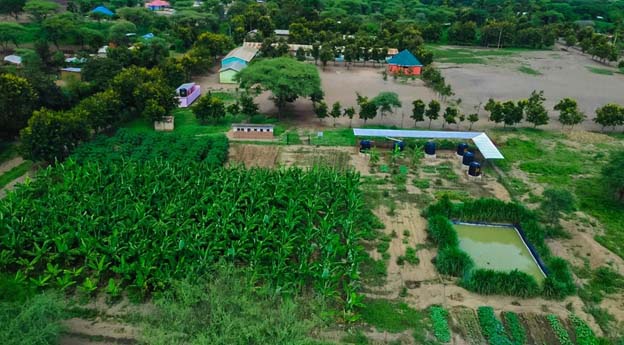
Even though women were not directly involved in the preparation and gardening stages because of cultural norms, Ruth and other parents are actively involved in gathering food, and she sees the impact of the garden on the children, including hers.
“During the planting stages, women were not allowed to enter the garden because such work as digging holes was considered men’s work, but now we can get much more food than we could get from the sellers outside,” she said.
Food from the garden not only provides children with the necessary nutrients for proper growth, such as vitamin A and other essential nutrients, but also a class for children to acquire hands-on training in agriculture and accountability.
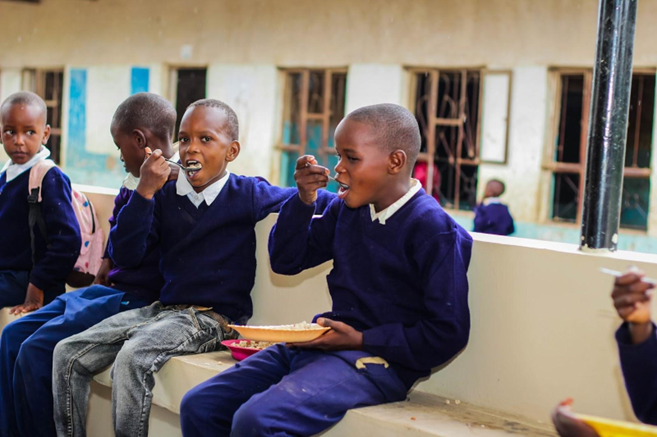
Moreover, the garden also helped stabilize costs. Produce from the garden lowers the pressure of having to wonder about meals, at least for lunch, and when there is a surplus, it gets sold in the local market and surrounding community, including Ruth, to ensure the cycle continues. “I am glad that I don’t have to stress anymore about my children’s lunch because I know they will be provided for at school, and I can focus on building our lives better,” she says with relief.